What is World Vegan Day?
Sandra Higgins speaks with Adrian Kennedy on The Agenda, LMFM Radio
Following World Vegan Day, Adrian Kennedy, The Agenda, LMFM invited Sandra Higgins to explain to listeners what it is and what its goals are.
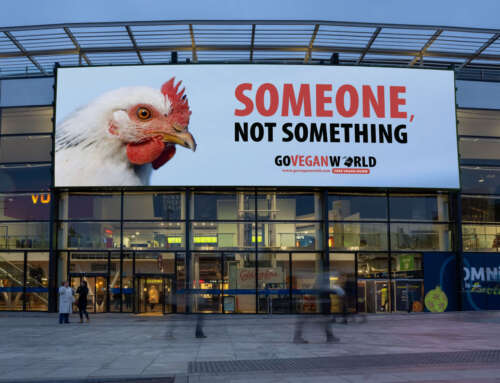
World Vegan Day celebrates the founding of the UK Vegan Society when the word vegan was coined. It is the start of World Vegan Month which is used by animal rights activists to educate people about the philosophy of veganism and how being vegan is the core of our moral obligation to others, human and non-human. So, it is worth pausing for a moment to consider what veganism actually means. It is a moral philosophy that recognises other animals as beings with feelings who value their lives. It rejects the notion that we are superior to other animals and that they are ours to use. It accepts that they are Someone, Not Something.
Our goal is the emancipation of other animals so that they are no longer used as resources or commodities by humans.
There is a misconception that veganism is a diet or a lifestyle. But while there are behaviours that characterise veganism such as not paying for the use of other animals for food, clothing, education, entertainment etc, what defines veganism is acceptance of the fact that other animals are feeling beings who share our fundamental right not to be used or killed. Being vegan is not a diet. It is a radically different way of thinking about other animals to that of the status quo which regards them as resources rather than feeling begins and imagines them to be inferior to humans. World Vegan Month is one of the opportunities we use to educate the non-vegan public in such a way that they are not left with the misconception that veganism is a diet or that it is an animal welfare or anti-animal cruelty movement. Veganism is a way of living that reflects the philosophy of animal rights. Other animals have the right not to be bred, owned by us, controlled by us, used by us or killed. Animal Rights Activists and those who promote veganism are not advocating for better ways of treating the animals we exploit. We are advocating the end of human use of other animals.
Take, for example, the recent case of the botched execution and torture of Christa Pike in Tennessee: human rights activists are not arguing for more humane ways of execution; they are arguing for an end to the death penalty. Animal rights activists do not argue for minor improvements in how we exploit other animals or more humane ways of slaughtering other animals (these are animal welfare measures). We argue for an end to all human use of other animals.
Adrian asked Sandra how long she’s been vegan and what prompted her to make that decision.
In 2018, Sandra founded Eden Farmed Animal Sanctuary. She explains how that gave her the opportunity to see farmed animals up close in a way she hadn’t previously. She explains that she noticed that they have the same senses as us – sight, hearing, smell, taste and touch. She also acknowledged that they have brains that function like our human brains, interpreting and making sense of the information coming in from their senses such that they develop trust or recognise danger. They remember the past, anticipate the future, experience emotional states such as happiness and fear, and have the same physical experiences as us of pleasure or pain.
She mentions how working with hens rescued from the egg industry provided her with an education on how selective breeding has divorced the bodies and lives of farmed animals from who they are, who they were meant to be. Selective breeding causes them to over-ovulate, laying approximately an egg every day, in the same way it causes animals in the dairy industry to over-produce milk and animals in the flesh industry to carry excessive amounts of muscle tissue so that the eggs, milk and flesh can be consumed by humans.
Sandra also describes a pivotal moment for her when she visited a dairy and learned that for us to have dairy products, newly born animals are separated from their mothers. As a psychologist with an interest in how the mother:child bond is integral to our psychological wellbeing, she was shocked to realise that this sacred bond is desecrated by separation of calves from their mothers as standard practice on dairy farms. As a result of visiting that dairy, Sandra went vegan overnight.
The interviewer seemed extremely uncomfortable as Sandra discussed the tragedy of dairy production for the animals exploited in the industry and he interrupted her with a listener’s concern about the lack of B12 on a plant-based diet.
Many people are uncomfortable when they learn that our unthinking patterns of living have such dreadful consequences for other animals. This discomfort occurs because most of us know that other animals matter and we don’t want to harm them. Yet, it is undeniable that living as a non-vegan means living in ways that contradict our claimed morals.
The listener’s question about nutrition is not irrelevant: Sandra explains how she was concerned about her own health when embarking on veganism which includes a 100% plant diet. She explains that these kinds of health concerns emanate from the misinformation we are fed by the animal agriculture industry that influences members of the public into believing animal products are necessary for human health. She clarifies that all the major world dietetics associations state that a plant diet can meet all our nutritional needs and stressed that it is important that people eat responsibly, finding ways to ensure their diet is adequate such as eating fortified foods or taking supplements.
Adrian also asked Sandra about the public awareness of veganism in the last few years. When Go Vegan World first used advertisements as a form of vegan education in Ireland in 2015 (Go Vegan Ireland), there was tremendous backlash and misunderstanding about veganism. Many people did now know what it was and could not even pronounce the world. The work of animal rights activists, and the development of social media, have ensured that veganism is now something most people recognise. However, as Adrian’s question on the popularity of veganism illustrates, there is still a gross misunderstanding of what it is and how it relates to animal rights. Veganism is a moral philosophy that respects other animals as sentient beings with rights, with the goal of animal emancipation. In that sense, popularity is irrelevant. Veganism is a social justice issue in the same way that women’s rights, and civil rights are. However, in recent years there has been a plethora of replacements for animal products that cater for the behavioural aspects of living without using other animals. It is the manufacture and promotion of these issues that can wax and wane in popularly. While they are an asset to people who are thinking of going vegan or have just begun to live vegan, and make the change very easy, they are not necessary for living without using other animals. Many of us went vegan decades ago when none of the current replacements were available. We do not need alternatives to do what is right.